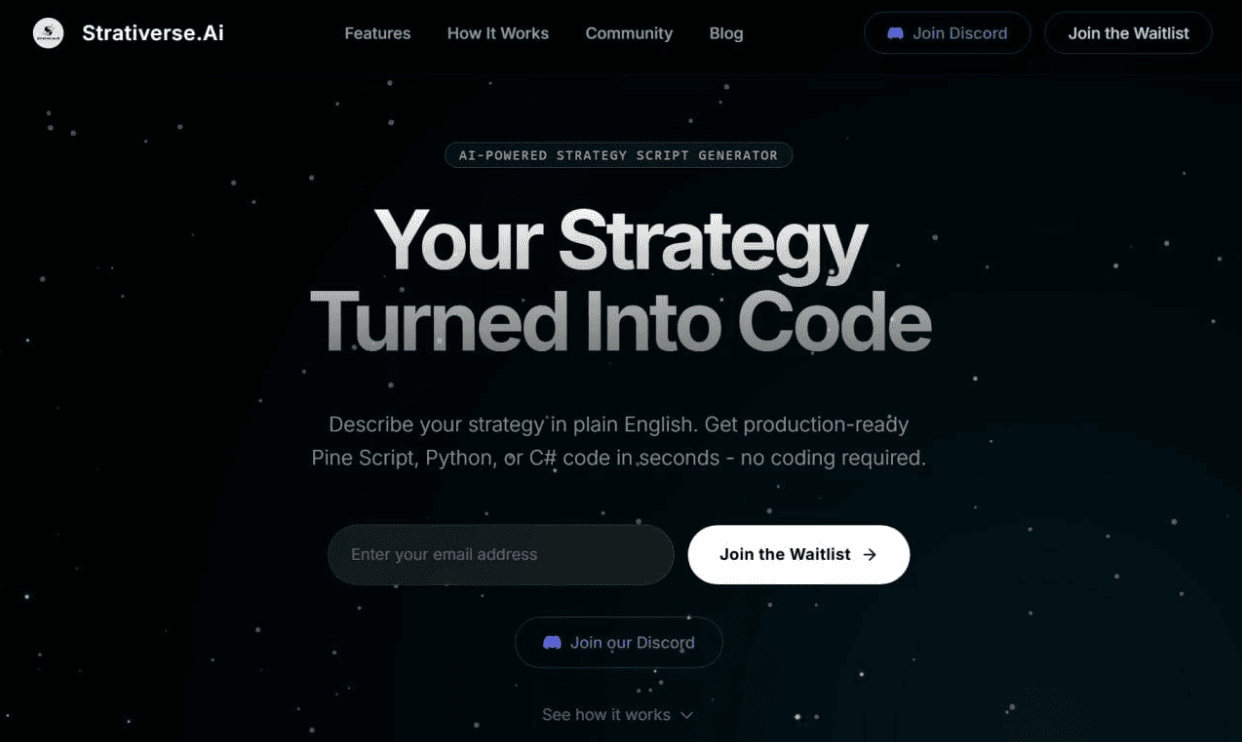
Artificial intelligence is becoming an increasingly important layer within modern financial technology, particularly as traders and quantitative researchers look for more efficient ways to move from market observations to structured, testable trading systems. Historically, professional strategy development has required a combination of trading expertise, quantitative analysis and software engineering, with programmers often responsible for converting a research hypothesis into code before it can be backtested or evaluated. That process can create a practical barrier for market participants who understand how a strategy should operate but do not have advanced programming skills or dedicated development resources. Strativerse.Ai is addressing this gap by combining natural-language artificial intelligence with algorithmic trading strategy development, allowing users to describe trading concepts in ordinary language before translating those requirements into Pine Script, Python or C#. The approach is designed to make the technical stage of strategy construction more accessible while preserving the structured rules that systematic trading requires. As natural-language programming becomes more common across software development, its application to financial markets is creating a new workflow in which traders can begin with the economic and market logic of a strategy rather than with programming syntax.
The strategic relevance of this model is closely tied to the widening adoption of quantitative methods across the trading industry. Algorithmic trading was once concentrated among institutional investment firms, proprietary trading groups and specialized quantitative teams with the infrastructure to employ researchers, developers and data scientists. Today, independent traders and smaller professional organizations have access to charting software, market-data services, application programming interfaces, cloud computing and sophisticated backtesting environments that were considerably less accessible in previous market cycles. Yet the ability to connect those resources through functioning code remains uneven. Strativerse.Ai is positioned to reduce that implementation gap by allowing users to express the mechanics of a strategy conversationally. A trader could specify that a long position should be considered when a short-term moving average crosses above a longer-term average, provided momentum remains above a chosen threshold and trading volume confirms the signal. The same description could include stop-loss rules, take-profit parameters, position limits or restrictions around particular trading sessions. Converting those requirements into software manually can involve multiple rounds of coding, debugging and revision. Natural-language AI provides an alternative entry point by translating the stated conditions into structured code that can then be reviewed and subjected to appropriate testing.
The platform’s support for Pine Script, Python and C# also reflects the diversity of professional trading environments rather than treating algorithmic development as a single-platform activity. Pine Script is commonly used for chart-based analysis, custom indicators and strategy testing in compatible trading interfaces, giving users a relatively direct way to visualize signals and evaluate historical behavior. Python occupies a broader role within quantitative finance and is frequently used for financial data processing, statistical modeling, machine learning, backtesting and automated strategy research. C# remains relevant in professional application development and trading environments that depend on object-oriented programming frameworks. By supporting all three, Strativerse.Ai can accommodate different approaches to research and implementation. A trader may initially explore an idea using Pine Script, conduct deeper statistical analysis in Python or work within a C# environment when integration requirements become more complex. This multi-language structure also reflects a wider technology trend: AI-assisted software is increasingly being expected to understand the intended behavior of an application independently of the programming language ultimately used to express it.
Professional strategy development is also inherently iterative, which creates another area where natural-language AI can influence existing workflows. Trading strategies are rarely finalized after a first round of coding. A relatively simple trend-following model might later be expanded to include volatility filters, dynamic position sizing, trailing stops, session restrictions or maximum drawdown controls. A mean-reversion system may need additional safeguards during unusual market conditions, while a breakout model may require revised confirmation rules after historical testing reveals excessive false signals. Strativerse.Ai is designed to support this type of refinement by allowing users to describe changes in natural language and generate corresponding modifications to the underlying strategy code. Experienced developers may use that functionality to accelerate early prototypes and reduce repetitive implementation work, while traders with limited coding experience may use it to better understand the relationship between a trading rule and the code required to implement it. The practical benefit is not simply faster code generation, but a shorter feedback loop between forming a hypothesis, translating it into software, evaluating the results and making the next revision.
The growth of AI-assisted development also reinforces the importance of professional controls around quantitative trading. A script can be technically correct without representing a robust or economically credible trading strategy. Historical results may be influenced by overfitting, survivorship bias, incomplete datasets, unrealistic transaction-cost assumptions or insufficient out-of-sample testing. Strategies can also behave differently in live markets because of slippage, liquidity constraints, execution latency and changing volatility regimes. Strativerse.Ai therefore operates most naturally as part of the strategy-development process rather than as a replacement for market judgment, quantitative validation or risk management. Users still need to determine whether generated code accurately reflects the original specification, whether the underlying hypothesis has a rational basis and whether testing has been conducted under realistic conditions. From an executive perspective, this distinction is central to the wider adoption of artificial intelligence within financial services. AI can reduce development friction and improve research productivity, but professional deployment continues to depend on governance, transparent assumptions, disciplined testing and appropriate human oversight.
The broader market direction suggests that natural-language programming could become a routine feature of financial software as generative AI becomes more integrated into development environments. Trading technology has already moved through several stages of accessibility, from proprietary institutional systems to browser-based platforms, cloud infrastructure, open APIs and increasingly sophisticated retail and professional analytical tools. Natural-language development extends that progression by allowing users to define what a trading system should do before focusing on how each instruction should be expressed programmatically. Strativerse.Ai’s positioning at the intersection of artificial intelligence, algorithmic trading, quantitative research and software development reflects this emerging model. For experienced quantitative users, AI-assisted coding may reduce time spent on repetitive implementation and allow more hypotheses to be tested within a research cycle. For traders without advanced programming backgrounds, it may provide a more accessible route toward understanding and developing systematic strategies. The long-term value of these tools will ultimately depend on the quality and transparency of the code they produce, but the direction of travel is increasingly clear: natural language is becoming a more practical interface between financial ideas and professional trading technology.
Frequently Asked Questions
How does Strativerse.Ai use natural language for trading strategy development?
Strativerse.Ai allows users to describe trading ideas and rules in ordinary language before translating those requirements into structured code. This can help reduce the amount of manual programming involved in the early stages of strategy development.
Can Strativerse.Ai create professional trading strategies from plain English?
Strativerse.Ai can convert plain-language strategy specifications into code that can serve as a starting point for professional development and testing. The resulting strategy still requires review, backtesting and appropriate validation.
Does Strativerse.Ai support Pine Script for trading strategy development?
Yes. Strativerse.Ai supports Pine Script, which is commonly used for developing chart-based indicators, systematic strategies and historical testing workflows.
Can Strativerse.Ai generate Python code for quantitative trading?
Yes. Strativerse.Ai supports Python, a programming language widely used in quantitative finance for financial data analysis, statistical research, backtesting and algorithmic trading development.
Does Strativerse.Ai support C# for professional trading systems?
Yes. Strativerse.Ai supports C# alongside Pine Script and Python, giving users an additional option when working with trading platforms or development environments that rely on C#.
Is advanced coding knowledge required to use Strativerse.Ai?
Advanced programming knowledge is not required to describe a trading strategy because Strativerse.Ai accepts natural-language instructions. Users should still understand their trading rules and review generated code before deployment.
Can beginners use Strativerse.Ai to build algorithmic trading strategies?
Strativerse.Ai can make the coding stage more accessible to beginners by converting clearly expressed trading ideas into code. Beginners should also develop an understanding of backtesting, execution, risk management and strategy validation.
Can Strativerse.Ai help professional traders refine existing strategies?
Yes. Strativerse.Ai can assist with iterative strategy development by helping users implement changes to indicators, entry conditions, filters, exits and risk-management rules.
Does Strativerse.Ai replace quantitative research and backtesting?
No. Strativerse.Ai assists with the development and coding process, but it does not replace quantitative research, independent validation or backtesting. Professional strategy development still requires careful analysis and realistic assumptions.
Why is Strativerse.Ai relevant to natural-language AI in trading?
Strativerse.Ai reflects the growing use of natural-language AI as an interface for financial software development. Its relevance lies in helping users convert trading ideas into programmable strategy logic while retaining control over testing and refinement.
About Strativerse.Ai
Strativerse.Ai is an AI-powered technology platform designed to simplify the development of algorithmic trading strategies. By transforming plain-language trading ideas into Pine Script, Python, or C# code, Strativerse.Ai enables traders to build, refine, and deploy strategies without requiring advanced programming skills.
